.png "X (Formerly Twitter)")




The Philippine Navy currently needs more vessels to uphold its mandate as a maritime branch of the Armed Forces of the Philippines. Also, its Coast Guard counterparts badly need the same thing on their own fleet. And with these concerns underly the basic point of this discussion matter that primarily aims to understand the nature of it with regards to securing the waters.
HEADLINE REPORTS
For instance, the recent clash between the government and the Abu Sayyaf group in an unlikely place like Bohol gave necessary importance to the discussion of having internal Maritime Domain Awareness, wherein in intelligence discussion that this article cited, military improvements are needed in a sense that additional naval assets gave a boost in improving maritime security, in which it was currently covered by the Philippine Navy's own Modernization Program called the Sail Plan, in which it addresses the areas of the maritime branch that needs improvement.
Another example is the so-called harassment by the Chinese against the Filipino fishermen over the disputed area in the West Philippine Sea (South China Sea) called "Union Banks". Verification was made by the Philippine Navy where in that matter one is indeed unsure about the identities of these said Chinese harassers whether it may be their Navy or Coast Guard. That also suffices the necessary understanding of the Maritime Domain Awareness (MDA) and its necessity where enhancing maritime security is a high priority for that matter.
Also to take note, multiple incursions took place along the waters surrounding the Philippines that are covered under this topic. From the border with Taiwan in the Bashi Channel down to the Sulu Sea as well as from the West Philippine Sea to the Benham Rise in the East, it was shown that enhancement of maritime security upon these matter as well as emphasizing MDA in the sense that incursions really are being informed as far as present needs are concerned.
These being said, both the Philippine Navy and the Philippine Coast Guard are keen on modernizing fleets as well as increasing the number of gray and white hulls respectively to further fulfill their mandates to protect the nation's coastline as well as improving maritime security as well as Maritime Domain Awareness. And in line with these things, here are some of the recent progress of both organization's vessels procurement in which it hopes that mandates are to be fulfilled. But before we proceed there, let us discuss the very definition of Maritime Domain Awareness or MDA.
DEFINITION
National Coast Watch System
The first fundamental to have for an effective MDA is a coast watch system. In this case, the Philippines is obtaining it, coming in a form of the National Coast Watch System (NCWS), wherein its purpose aims to have much, secure territorial water within an archipelagic nation in which the Philippines consists of.
Referencing the Indo-Asia-Pacific Defense Forum article, the writer whose identity is within the ranks in the Philippine Navy, emphasized that a system or mechanism such as NCWS is a necessity to protect marine wildlife, environment, natural resources, and the domain it coincides wherein apparently, the main goal is to resolve various maritime issues as per this discussion matter.

HEADLINE REPORTS
 |
| Flight III Pohang-class Corvettes. Take note that the Philippines will be about to have ROKN Chungju soon. From Wikimedia Commons |
The topic about Maritime Domain Awareness varies from internal defense issues up to territorial-based ones. All of it pertains to the necessity of protecting the waters surrounding an archipelagic nation like the Philippines.
For instance, the recent clash between the government and the Abu Sayyaf group in an unlikely place like Bohol gave necessary importance to the discussion of having internal Maritime Domain Awareness, wherein in intelligence discussion that this article cited, military improvements are needed in a sense that additional naval assets gave a boost in improving maritime security, in which it was currently covered by the Philippine Navy's own Modernization Program called the Sail Plan, in which it addresses the areas of the maritime branch that needs improvement.
Another example is the so-called harassment by the Chinese against the Filipino fishermen over the disputed area in the West Philippine Sea (South China Sea) called "Union Banks". Verification was made by the Philippine Navy where in that matter one is indeed unsure about the identities of these said Chinese harassers whether it may be their Navy or Coast Guard. That also suffices the necessary understanding of the Maritime Domain Awareness (MDA) and its necessity where enhancing maritime security is a high priority for that matter.
Also to take note, multiple incursions took place along the waters surrounding the Philippines that are covered under this topic. From the border with Taiwan in the Bashi Channel down to the Sulu Sea as well as from the West Philippine Sea to the Benham Rise in the East, it was shown that enhancement of maritime security upon these matter as well as emphasizing MDA in the sense that incursions really are being informed as far as present needs are concerned.
These being said, both the Philippine Navy and the Philippine Coast Guard are keen on modernizing fleets as well as increasing the number of gray and white hulls respectively to further fulfill their mandates to protect the nation's coastline as well as improving maritime security as well as Maritime Domain Awareness. And in line with these things, here are some of the recent progress of both organization's vessels procurement in which it hopes that mandates are to be fulfilled. But before we proceed there, let us discuss the very definition of Maritime Domain Awareness or MDA.
DEFINITION
 |
| Realizing Global Maritime Surveillance. From the Global Economic Symposium |
The Maritime Domain Awareness, as interpreted by International Maritime Organization, is written as follows:
"The effective understanding of any activity associated with the maritime environment that could impact the security, safety, economy or environment."
Moreover, it is also good to know that Navies like those of the United States also have their own concept over the Maritime Domain Awareness in the form of a document that can be downloaded here.
"The effective understanding of any activity associated with the maritime environment that could impact the security, safety, economy or environment."
Moreover, it is also good to know that Navies like those of the United States also have their own concept over the Maritime Domain Awareness in the form of a document that can be downloaded here.
Apparently, the concept made by the United States Navy gives a background about it, wherein the respect to maritime security, securing commercial routes as well as coming up with the constant change of needs in maritime waters ranging from disaster relief to unconventional enemies are a necessity that each and the maritime nation has a role to play upon.
That being said, concerning the examples given above, the Philippines in its sad state needs to improve through the basis of implementing the modernization program that is currently taking place. Moreover, the definition as per basis also from the US Navy document also gives emphasis on timely, accurate decision making based on a continuous flow of information either it may be an intelligence report or a distress call where a necessary decision has been made whether it may be neutralizing the enemy or rescuing those who trapped in a conflict.
Also to take note, the Philippines in fact also have this development, coming in the form of the National Coast Watch System or NCWS, wherein apparently, it aims to have an effective MDA ranging from the piracy-infested Sulu Sea to the rest of the country.
Also to take note, the Philippines in fact also have this development, coming in the form of the National Coast Watch System or NCWS, wherein apparently, it aims to have an effective MDA ranging from the piracy-infested Sulu Sea to the rest of the country.
However, emphasis is badly needed that systems like this shall be improved where the activities aforementioned like more vessels as hoped, will be enhanced further. Now, let us discuss the recent developments regarding this matter.
THE RECENT DEVELOPMENTS
THE RECENT DEVELOPMENTS
 |
| Philippine Coast Guard's newest vessel, the Parola-class MRRVs like the BRP Malabrigo. Via Pacific Sentinel |
In line with their respective modernization efforts, both the Philippine Navy and Philippine Coast Guard are making a move on procuring more vessels to keep up with the mandate of protecting the archipelagic coastlines from various threats in the sense that its nature becomes complex considering that aside from territorial-based threats involving large ships, it also shall deal with internal threats especially on the cases of piracy and insurgency.
National Coast Watch System
The first fundamental to have for an effective MDA is a coast watch system. In this case, the Philippines is obtaining it, coming in a form of the National Coast Watch System (NCWS), wherein its purpose aims to have much, secure territorial water within an archipelagic nation in which the Philippines consists of.
Referencing the Indo-Asia-Pacific Defense Forum article, the writer whose identity is within the ranks in the Philippine Navy, emphasized that a system or mechanism such as NCWS is a necessity to protect marine wildlife, environment, natural resources, and the domain it coincides wherein apparently, the main goal is to resolve various maritime issues as per this discussion matter.
The NCWS was started as an executive order effective that went effective way back in the year 2011, in which it adheres to the United Nations Convention on the Law of the Sea or UNCLOS, itself being the very basis that made the Philippines made victorious on an arbitral tribunal where the Chinese Nine-Dash line was declared illegal in nature.
Apparently, it was started as the Cabinet Committee on Maritime and Ocean Affairs or CABCOM-MOA before it was renamed as Committee on Maritime and Ocean Affairs or CMOA. Eventually, as the NCWS was formed, it adopted the roles of CMOA in the hopes that the new system will cope up with the necessity of an effective MDA.
Moreover, the NCWS comes up with a vision whereupon summation, it simply aims to be a global maritime nation wherein maritime resources can be freely enjoyed by stakeholders like the national, regional, local, private sectors and international partners where in that sense, there will be no worries for anybody concern like the fishermen to gather up resources in the sea which it matters with their livelihood as well as those who are in shipping practices and the like.
Moreover, the NCWS comes up with a vision whereupon summation, it simply aims to be a global maritime nation wherein maritime resources can be freely enjoyed by stakeholders like the national, regional, local, private sectors and international partners where in that sense, there will be no worries for anybody concern like the fishermen to gather up resources in the sea which it matters with their livelihood as well as those who are in shipping practices and the like.
Also, like the US Navy interpretation on MDA, the NCWS aims to have an inter-agency information-sharing mechanism that is by nature institutionalized where decision-makers enable to monitor situations to make necessary actions upon the matter.
At present, its organization consists of secretaries from various Executive Departments of the Philippines with the NCWS chairman being the executive secretary.
At present, its organization consists of secretaries from various Executive Departments of the Philippines with the NCWS chairman being the executive secretary.
More so in that matter, the NCWS have coordination with regards to the information with different agencies in which it includes the Philippine Navy, Philippine Coast Guard as well as the others concerned both local, national and international. In that sense, maritime contacts among other foreign maritime enforcement alongside local stakeholders are as well essential to keep the waterways safe.
To summarise this up, the Philippines through the NCWS aims to be a leading maritime nation wherein governing the maritime domain is a necessity in the sense that Maritime Domain Awareness will be enhanced. With that goes hopes that this system will get improve as time goes by.
Philippine Navy
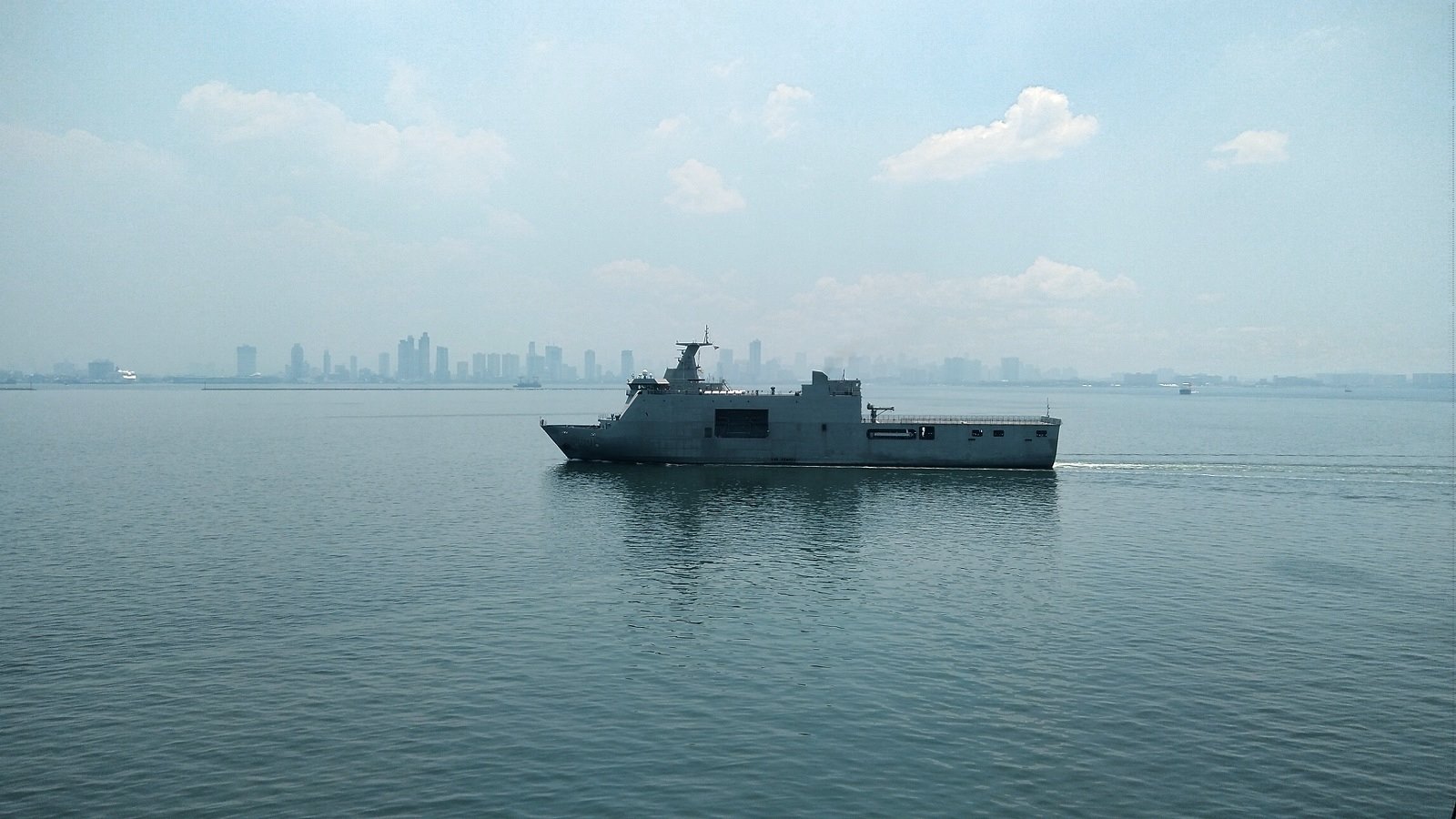
The Philippine Navy is currently looking for more vessels, both old and new, to be in its fleet. At present, the ships that it obtained for the last five to seven years include the Del Pilar-class Patrol Frigates, Tarlac-class LPDs, the Australian-imported Balikpapan-class vessels, and several others.
Recent developments about more assets go by with the latest focusing on the Philippine Navy's interest in procuring a Pohang-class corvette from South Korea in which the said vessel is said to be named as "ROKN Chungju" or PCC-762.
To summarise this up, the Philippines through the NCWS aims to be a leading maritime nation wherein governing the maritime domain is a necessity in the sense that Maritime Domain Awareness will be enhanced. With that goes hopes that this system will get improve as time goes by.
Philippine Navy
The Philippine Navy is currently looking for more vessels, both old and new, to be in its fleet. At present, the ships that it obtained for the last five to seven years include the Del Pilar-class Patrol Frigates, Tarlac-class LPDs, the Australian-imported Balikpapan-class vessels, and several others.
Recent developments about more assets go by with the latest focusing on the Philippine Navy's interest in procuring a Pohang-class corvette from South Korea in which the said vessel is said to be named as "ROKN Chungju" or PCC-762.
Apparently, the said vessel comes as a welcoming addition to the Navy, in which the antisubmarine capabilities it obtained, may help the Navy servicemen to enhance their capabilities as preparation for the arrival of the Brand New Frigates, which is also from South Korea.
These capabilities are also a good thing for Maritime Domain Awareness to have where information about surface vessels is not only the matter for territorial water security, but also it pertains to what lies underwater where maritime security is further ensured out.
More unto this, the Philippine Navy is keen on having more vessels where it seems to be straight out of mere desperation where with increasing incursions, so does the need for enhancing MDA.
More unto this, the Philippine Navy is keen on having more vessels where it seems to be straight out of mere desperation where with increasing incursions, so does the need for enhancing MDA.
In that case, various reports suggest about the Navy's calling or planning to procure the Australian Adelaide-class Frigates in which it was also getting interested from both Taiwan and Poland as well whereas per discussion in the past, these ships, being in a class similar to the Oliver Hazard Perry-class Frigates, are to be considered as gas guzzlers in the sense that the Royal Australian Navy reportedly operating the ships at the cost of $279,235 a day. That is if it includes the highly-paid salaries as well as the so-called superannuation or benefits for that matter. Might as well consider the role of the ship as combat ships rather than as patrol ships as per this article.
That being said, it may be different to the ships that are deemed patrol in nature wherein that sense, presence is also a necessity in such a way that being part of Maritime Domain Awareness, a presence of any vessel like Offshore Patrol Vessels is enough to show that such part of territorial waters are enforced and within national jurisdiction. And speaking of offshore patrol vessels, there is also one project or plan that has about this matter.
Introducing, the Portuguese Corvettes. The said ships pertain to both Joao Coutinho and Baptista de Andrade-class corvettes that are all variants of Spanish Descubierta-class Corvettes. Apparently, there are no confirmed channels as per it aside from one defense outlet which primarily discussed the possible transfer. That being said, inspections as per reports are said to be ongoing, where there are no updates about that matter at the time of this article's posting. In this, all of it remains to be seen until an update, if it seems necessary, shall be made.
There is more for the Navy to procure as per Sail Plan in which goes in line with an effective Maritime Domain Awareness. That which, may go in line with the larger AFP Modernization Program which also deals in improving other fields like the Philippine Air Defense System or PADS.
Introducing, the Portuguese Corvettes. The said ships pertain to both Joao Coutinho and Baptista de Andrade-class corvettes that are all variants of Spanish Descubierta-class Corvettes. Apparently, there are no confirmed channels as per it aside from one defense outlet which primarily discussed the possible transfer. That being said, inspections as per reports are said to be ongoing, where there are no updates about that matter at the time of this article's posting. In this, all of it remains to be seen until an update, if it seems necessary, shall be made.
There is more for the Navy to procure as per Sail Plan in which goes in line with an effective Maritime Domain Awareness. That which, may go in line with the larger AFP Modernization Program which also deals in improving other fields like the Philippine Air Defense System or PADS.
This goes with the hope that the Philippine Navy shall enhance its capabilities considering that the nation is archipelagic in geography where the vast territorial waters being the front lines.
Philippine Coast Guard
Like the Philippine Navy, the Philippine Coast Guard is also keen on having new vessels, in the hopes that it can further do its mandate of defending the Philippine coastlines as well as enforcing local maritime laws to its jurisdiction in which in itself supplements for an idea for Maritime Domain Awareness.
The coast guard recently takes deliveries from Japan as part of a loan supplementing 10 multi-role response vessels or MRRVs. This is the Parola-class patrol vessel where BRP Tubbataha (MRRV-4401) in itself is a lead vessel.
Philippine Coast Guard
Like the Philippine Navy, the Philippine Coast Guard is also keen on having new vessels, in the hopes that it can further do its mandate of defending the Philippine coastlines as well as enforcing local maritime laws to its jurisdiction in which in itself supplements for an idea for Maritime Domain Awareness.
The coast guard recently takes deliveries from Japan as part of a loan supplementing 10 multi-role response vessels or MRRVs. This is the Parola-class patrol vessel where BRP Tubbataha (MRRV-4401) in itself is a lead vessel.
Also to take note, other ships of the same class as per the posting of this article are in the coast guard inventory. These ships are the BRP Malabrigo (MRRV-4402) and BRP Malapascua (MRRV-4403).
In this manner, the coast guard is still expecting the remaining seven vessels of the same class in which at present is still in Japan where it is still under production. It will take time until all of the 10 multi-role response vessels are delivered which will complement the other ships that are already in service within the organization.
Aside from the Parola-class patrol vessels, the Philippine Coast Guard has also opted for larger ships that are also from Japan. To be specific, it pertains to the 92m vessels wherein it may be far more capable than the MRRVs especially on deployment beyond the coastline.
Aside from the Parola-class patrol vessels, the Philippine Coast Guard has also opted for larger ships that are also from Japan. To be specific, it pertains to the 92m vessels wherein it may be far more capable than the MRRVs especially on deployment beyond the coastline.
If all goes well, it will be complementing other vessels in which in particular, the 10 multi-role response vessels coming from the same nation these ships will be built. Apparently, there is little news as for it at present aside from last year's articulation, but one hopes that it will be materialized as well alongside the already-in-process MRRVs.
Japan is not only the source for the Philippine Coast Guard vessels. France may also be the source of coast guard vessels as Coast Guard officials inspected these 24m vessels which are considered brand new just like its Japanese counterparts and it comes up with four units. Moreover, the coast guard also opted for a single 82-meter vessel from the said country which makes the overall ships planning to procured to five units. The said 82-meter vessel pertains to OPV 270 MKII which is one of the products showcased by the French company OCEA in Euronaval 2014. Given the missions of the OPV, it may seem to be one of the ideal ships the coast guard is keen to have where it will further enhance not only its capabilities but as well its mandate to conduct wherein it improves Maritime Domain Awareness.
To summarise this up, the coast guard, just like the navy is keen to have more vessels in which it also aims to protect and enforce maritime laws in the coastline in the sense that setting up jurisdictions is a necessity to ensure that anybody who passes by the waters adheres to the laws which make them safe as well as having privilege on gathering resources legally for livelihoods. Furthermore, more white hulls coincide with non-provocative presence where it coincides with sovereign rights just like the navy ships. All of which, may improve, enhance and make the nation's Maritime Domain Awareness a great standard.
THINGS TO PONDER
Given the recent situations such as the Chinese provocative actions against Filipino fishermen as well the unnoticeable passage of insurgents within territorial waters, it may be as good to say that these are the demoralizing moments there is that the nation's Maritime Domain Awareness is still not fully capable in these said areas where there may be more situations like this to come.
Japan is not only the source for the Philippine Coast Guard vessels. France may also be the source of coast guard vessels as Coast Guard officials inspected these 24m vessels which are considered brand new just like its Japanese counterparts and it comes up with four units. Moreover, the coast guard also opted for a single 82-meter vessel from the said country which makes the overall ships planning to procured to five units. The said 82-meter vessel pertains to OPV 270 MKII which is one of the products showcased by the French company OCEA in Euronaval 2014. Given the missions of the OPV, it may seem to be one of the ideal ships the coast guard is keen to have where it will further enhance not only its capabilities but as well its mandate to conduct wherein it improves Maritime Domain Awareness.
 |
| From a warship forum. |
THINGS TO PONDER
Given the recent situations such as the Chinese provocative actions against Filipino fishermen as well the unnoticeable passage of insurgents within territorial waters, it may be as good to say that these are the demoralizing moments there is that the nation's Maritime Domain Awareness is still not fully capable in these said areas where there may be more situations like this to come.
However, there are still hopes that it will all be far improved where agencies involved will be immediately deployed in due time. Take this bid bulletin for North Luzon's Coast Watch Station for instance alongside the incoming vessels for the coast guard and the navy. The said incursions, mishaps, and harassments, as once hoped, might be diminished if all goes well for the Maritime Domain Awareness. That is, upon the necessary things and factors per se are already in their respective place.
THE CATCH
THE CATCH
 |
| The Archipelagic Baseline, serving as a guide for Maritime Domain Awareness. |
The whole point of Maritime Domain Awareness is that it is deemed an essential thing for the Philippines to improve where through the so-called National Coast Watch System being enjoined together with the Philippine Navy and Philippine Coast Guard and their additional assets that presence, as well as maritime security, will be improved wherein people concerned like the fishermen in the sea will be safe from any various threats like foreign elements in the disputed sea, the sailors being safe from piracy in the Southwestern Philippines, and some others, wherein the instances that there will be no more worries about the said threats.
In that effectiveness. as well as the enhancement that the maritime security and the rules it coincides may prevail that the Philippines, through these secured waterways and better information as per maritime situations and the institutional way of disseminating it, will further improve its economy that in the end, all of those who rely on these maritime waters will be benefited a lot.

(c) 2017 PDA, revised 2021 edition.